What Is AEO (Answer Engine Optimization) and Why It Matters for Small Businesses in 2026

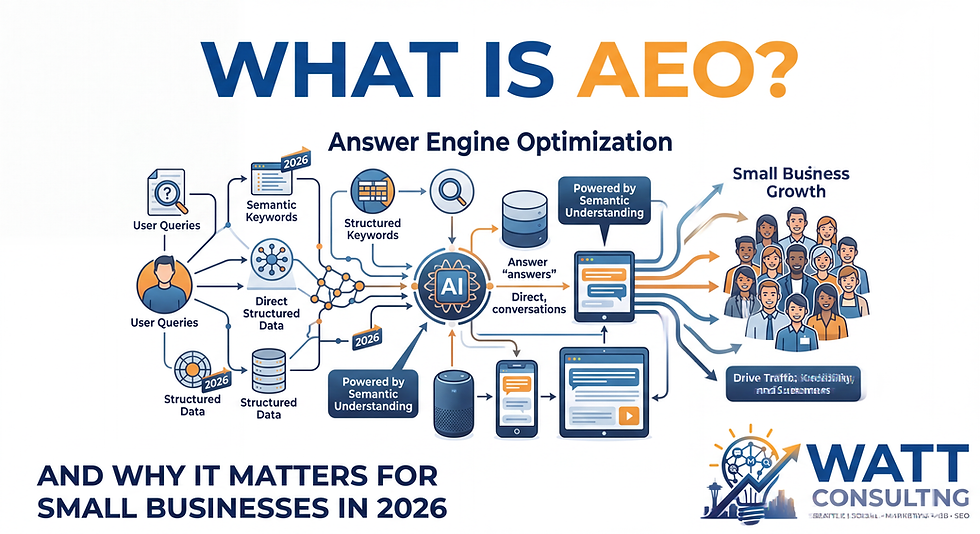
What Is AEO (Answer Engine Optimization) and Why It Matters for Small Businesses in 2026
**Answer Engine Optimization (AEO)** is the practice of structuring your website content so AI systems like ChatGPT, Google AI Overviews, Perplexity, and Gemini can find it, understand it, and cite it directly in the answers they give users. Where traditional SEO aims to get you ranked, AEO aims to get you *quoted* — often without the searcher ever clicking through to your site.
Why AEO Is a Different Game Than Traditional SEO
For twenty years, the goal of search marketing was simple: rank on page one of Google, and clicks would follow. That model is breaking down. A growing share of searches now end with an AI-generated summary sitting above the traditional blue links, and many users get their answer without scrolling further. If your business isn't the source behind that summary, you're invisible at the exact moment someone was deciding who to call.
This matters even more for small and local businesses than for national brands, because the queries people use to find you — "best plumber near me," "how much does a website redesign cost," "is [your business] good" — are exactly the conversational, question-based queries that AI answer engines are built to handle.
How AI Answer Engines Actually Choose What to Cite
Each platform works a little differently:
- **Google AI Overviews** summarize top-ranking pages, so strong traditional SEO still matters as the foundation.
- **ChatGPT and Perplexity** search the live web and cite sources directly, often pulling from a wider range of sites than just the top three Google results — including sites that rank on page two or three.
- **Perplexity** in particular favors content that's well-structured, recently updated, and backed by clear sourcing.
The common thread: these systems extract short, self-contained passages, not entire pages. A page can get cited even without a top Google ranking if a specific section of it directly and clearly answers the question being asked.
The Core Principles of AEO
1. **Answer the question immediately.** Open each page or section with a direct, plain-language answer before adding context or nuance.
2. **Write in extractable chunks.** Keep key answers to roughly 40–60 words so they can stand alone if pulled out of context.
3. **Use headings that match how people actually ask questions.** "How much does SEO cost in Seattle?" beats "Our Pricing Philosophy" as an H2.
4. **Back claims with specifics.** Statistics, dates, and named sources are cited far more often than vague claims like "we're the best."
5. **Add structured data.** FAQ schema and Article schema give AI systems explicit signals about what your content covers.
6. **Keep it fresh.** Content with a visible "last updated" date is trusted more than undated, static pages.
What AEO Does Not Mean
AEO is not about writing separate, robotic-sounding content just for machines. Google has been explicit that content built to be extracted by AI should still read naturally for people — the same page that earns a citation should also convert a human visitor. AEO also isn't a replacement for SEO; it's a layer on top of solid technical SEO, quality content, and Google Business Profile optimization.
Getting Started with AEO for Your Small Business
You don't need a developer or a six-figure budget to begin. Start by auditing how your top five most important pages open — do they answer the reader's question in the first sentence, or do they warm up for three paragraphs first? Add a short FAQ section to your most important pages using the real questions customers ask you on the phone. Make sure your Google Business Profile, website, and any directory listings all use the same business name, address, and phone number. Then check whether your robots.txt file is accidentally blocking AI crawlers like GPTBot or PerplexityBot.
Key Takeaways
- AEO is about earning citations in AI-generated answers, not just search rankings.
- AI engines extract short, self-contained passages — structure your content to answer questions directly and early.
- Statistics, expert attribution, and freshness dates all measurably increase how often content gets cited.
- AEO builds on top of good SEO; it doesn't replace it.
Frequently Asked Questions
Is AEO the same thing as SEO?
No. SEO focuses on ranking in traditional search results, while AEO focuses on getting cited inside AI-generated answers on platforms like ChatGPT, Perplexity, and Google AI Overviews. AEO relies on strong SEO fundamentals but adds structure specifically aimed at how AI systems extract and quote content.
Do I need to rewrite my whole website for AEO?
Not usually. Start with your highest-value pages — service pages, pricing, and your most-visited blog posts — and add direct-answer openers, FAQ sections, and clear headings. A full rewrite is rarely necessary if the underlying content is already accurate and useful.
How long does it take to see AEO results?
Most businesses start seeing early signs, like appearing in AI Overview snippets, within 1–3 months of restructuring key pages, though citation tracking is less mature than traditional rank tracking, so results can be harder to measure precisely.
Can a small local business really compete with big brands for AI citations?
Yes. AI answer engines don't only cite the biggest or highest-authority sites — they often favor whichever page most clearly and specifically answers the question, which levels the playing field for well-structured local content.
Ready to Get Found by AI Search?
Watt Consulting helps Seattle-area small businesses build websites and content that show up in Google *and* get cited by AI assistants. Start your project and let's audit your current AEO visibility.


Comments